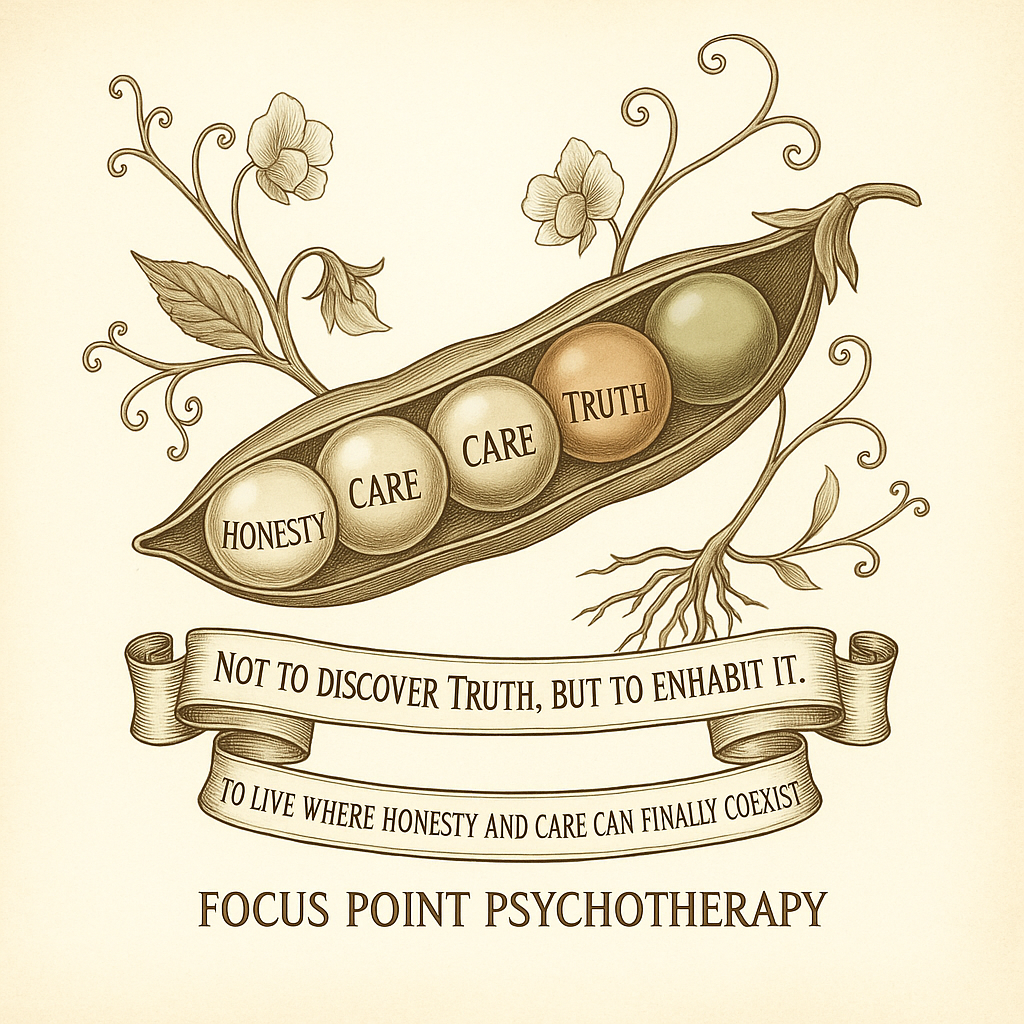
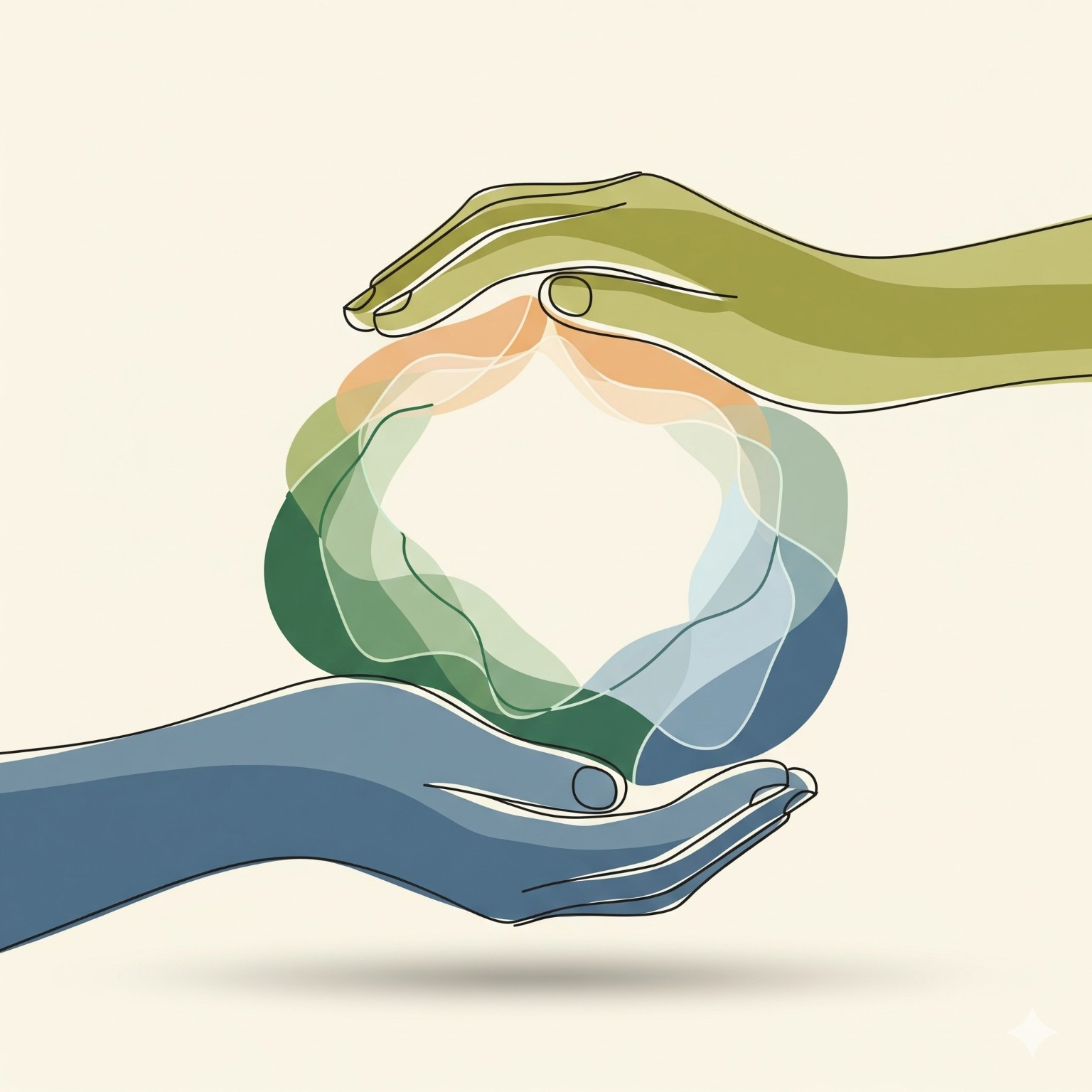
Unconditional love whispers: “You are enough as you are.” Expectation whispers: “I believe in what you can become.” At first, they sound like opposites. But they are not enemies — they are partners. Like soil and sunlight, they belong together. In many families, one side was missing: Love was conditional — acceptable only if you performed. Or acceptance without holding — leaving you adrift, without guidance.
🌱 Therapy, at its best, becomes a threshold space where both are restored: ✨ Acceptance → you belong here, rooted and safe. ✨ Expectation → your growth is seen and invited. Like a dragonfly pausing in the autumn light — fragile stillness and quiet possibility held in one frame — therapy, too, is this kind of threshold. Not only rest, not only growth, but the invitation to hold both together.
🍁 Autumn teaches us: letting go and preparing for new life can coexist. Love and expectation, rest and becoming, are not opposites — they are the conditions for flourishing.
I was struck by these lizards basking on brambles. Not because the thorns are kind — but because life finds a way to rest even in precarious places. Resilience isn’t about glorifying pain. It’s about noticing where warmth, balance, and possibility can emerge despite the roughness of our surroundings. In therapy, too, we often discover that healing doesn’t wait for everything to be smooth and safe. It begins when we learn to hold our place gently, even among life’s sharper edges — trusting that light and renewal can still reach us.
If you’re navigating thorny times, integrative psychotherapy can offer a space to pause, breathe, and rediscover your strength.
Much of my work as a therapist is about noticing what might be overlooked, minimised, or even discarded — and restoring it into meaning. Often, the very fragments we try to turn away from hold the thread of transformation. The three pillars of my practice are: 🌿 Relation → a commitment to deep attunement, meeting you as a whole person rather than an object to be fixed. 🌿 Reflection → metabolising experience so that meaning can unfold naturally through dialogue, image, and presence. 🌿 Truth → a willingness to name what is often avoided, with clarity and care. Therapy, for me, is not about erasing or bypassing what feels heavy. It is about creating a space where even the discarded parts of us can be seen, honoured, and restored into meaning. hashtag#Psychotherapy hashtag#IntegrativeTherapy hashtag#MentalHealthSupport hashtag#Counselling hashtag#MeaningMaking hashtag#RestoringMeaning hashtag#Truth
From I–It to I–Thou: Breaking the Price Tag in Contemporary Cinema
In a world where almost everything can be consumed, priced, or traded, even our most intimate relationships risk becoming commodities. Cinema often mirrors this reality: bodies as objects, love as transaction, desire as spectacle. Carl Rogers called this conditions of worth — the belief that “I am only valuable if…” Martin Buber called its relational shadow I–It: treating others as things to use, rather than beings to meet. But what happens when films turn these conditions into literal flesh and money — and then, briefly, crack them open?
Fall for Me: Desire Beyond the Male Gaze In Netflix’s Fall for Me, eroticism could easily have become voyeuristic. Instead, it pulses with rare equality. Svenja Jung and Theo Trebs are both subjects and objects of desire, equally exposed to the camera’s gaze. The symmetry resists the traditional male gaze, creating erotic tension that is mutual, vulnerable, and authentic. This is not I–It consumption, but a flicker of I–Thou: two beings meeting, seeing, and being seen.
Mickey 17: The Disposable Man Bong Joon-ho’s Mickey 17 makes consumerism visceral. Mickey’s body is endlessly reproduced, used, and discarded — a man turned into product, his worth tied only to utility. Yet salvation arrives not from humans, but from aliens who treat him with care and reverence. They see him not as a resource, but as a person. They break the cycle of I–It and restore him to Thou. Rogers might call this unconditional positive regard: value that is not earned, but given.
Anora: Disarmed by Honesty Sean Baker’s Anora is saturated with price tags — sex work, marriage deals, money changing hands. Anora’s worth is continually measured by transactions. And yet she is undone, not by wealth, but by honesty: a man who meets her without performance, without price. In that moment, she is no longer an It, but a Thou — a person met, not consumed.
A Shared Gaze, A Shared Humanity All three films reveal the same tension: consumerism reduces people to conditions of worth — desirable, profitable, useful. But each also points to what breaks the cycle: care, respect, honesty, equality. In these moments, Rogers and Buber overlap. Rogers’ unconditional positive regard and Buber’s I–Thou are cinematic twins, naming the same radical truth: that a person is valuable not because of what they offer, but simply because they are. And maybe that is why these films resonate. In a culture of price tags, the most subversive act is still the simplest: to look at another human being and truly see them.
✨ What do you think? Have you seen moments in cinema where the I–Thou breaks through consumerism’s I–It?
Lotus flowers bloom in still water — not in spite of the mud below, but because of it. At Bongeunsa Temple, I stood before this quiet marvel and thought about the courage it takes for people to grow in difficult conditions.
In therapy, as in life, we don’t erase the mud. We learn how to draw nourishment from it. And sometimes, in the right light, that growth becomes something luminous.
Creativity isn’t just what you make — it’s the way you see.
But when you live with a mind that’s always weaving, dreaming, and searching for meaning, that richness can become heavy to hold. The very depth that fuels your work can also tip into overwhelm, self-doubt, or creative block.
I work with artists, writers, performers, designers, and innovators to help them reconnect with their creative core — without losing themselves to the demands, expectations, and noise around them.
Through a creative, integrative approach — blending psychological insight, emotional attunement, and symbolic exploration — we trace the threads between your inner world and your outer life.
I understand what it means to think and see outside the box — as many creatives do — and I offer that same expansive, non-linear perspective in therapy 🪷. This is a space where your imagination, sensitivity, and complexity are met on their own terms, and where what feels tangled or difficult can become a resource to be integrated.
Whether you’re navigating burnout, perfectionism, anxiety, or simply longing for a place where you’re understood beyond your output — you’re welcome here.
In life, we move through roles — therapist, parent, professional, survivor, leader, child. Some chosen. Some inherited. Some imposed.
We wear them to function. To connect. To survive. But what if we wore them like silk, not armour?
Light enough to let the core shine through. Soft enough to move with us — not against us. Strong in structure, but never rigid. Paper-thin. Soul-visible.
In Still, Michael J. Fox reflects:
“An actor’s burning ambition is to spend as much time as possible pretending to be somebody else.”
And yet, even in performance, his soul shone through — because the layer of a role was thin enough for light to pass.
Later, he shares:
“Only when it became virtually impossible for me to keep my body from moving would I find the peace, security, and spiritual strength to stand in one place.”
That stays with me.
Because in a world that so often pushes us into roles — what if we were allowed to let the self shine through them? What if they could hold us lightly — not define us completely?
Michael showed us how to let the performance fall away — not to disappear, but to come home.
In stillness, he became more himself than ever before.
Thank you, Michael J. Fox, for showing us how to let our souls shine through — with courage, grace, and quiet brilliance.
In my work, I often tune into images — symbolic echoes of a client’s inner world.
These images can emerge as metaphors, shapes, dream fragments, or felt impressions — co-created in the space between us. They help us see what language can’t yet name.
Whether you think in visuals, symbols, or sensations, therapy can be a place to honour that inner language — gently, respectfully, and with curiosity.
Sometimes the work is not about explaining, but witnessing. Not naming, but noticing. This is where meaning begins.
“What we see changes what we know. What we know changes what we see.” — Jean Piaget
In therapy, insight often begins with a shift in perception — a new way of seeing ourselves, our past, or our relationships.
This seeing isn’t always comfortable, but it’s often liberating. A space of quiet re-orientation. A slow turning toward truth.
We might call it reframing — not rewriting the story, but holding it differently. With more context. More compassion. And just enough light to move forward.